The real-time autonomous immune system for mobile defense.
Enterprise-grade, on-device security for sovereign and enterprise Android fleets. Detect, contain, and neutralize threats in seconds, without sending sensitive data to the cloud.
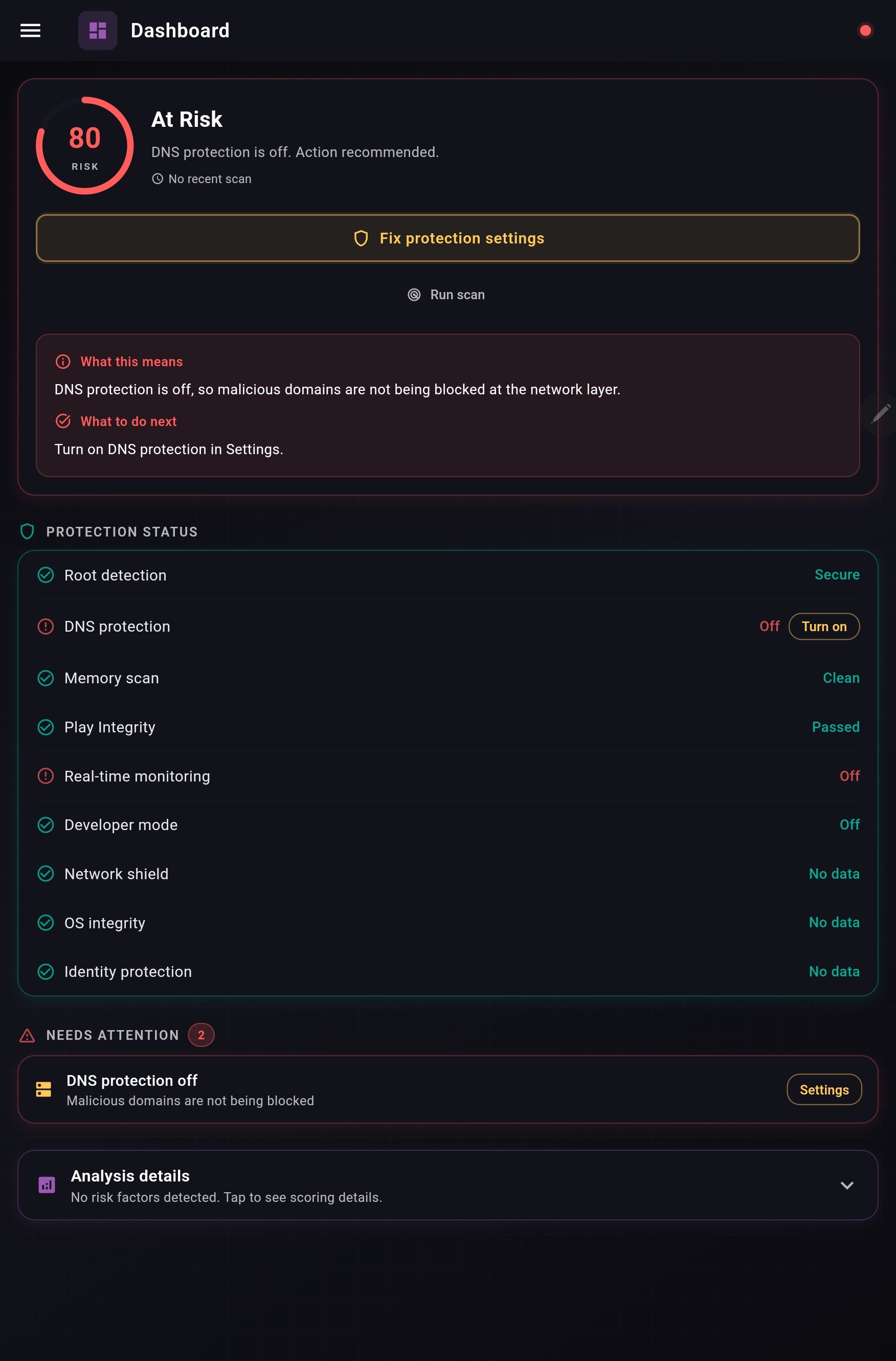
Mobile is the primary attack surface, and it's evolving fast.
Phones now carry the credentials, MFA codes, and access that attackers want most. Mishing, malicious apps, DNS tunneling, and polymorphic malware are outrunning legacy defenses.
Why traditional mobile threat defense falls short.
Legacy MTD platforms create critical vulnerabilities in zero-trust environments. Four structural failures show up again and again.
Cloud-update latency
Most MTD tools depend on cloud updates to stay current, leaving gaps in air-gapped, contested, or degraded network environments.
The handcuffed defender
Mobile security today can detect threats but rarely stop them in real time. Detection without autonomous response isn't defense.
Privacy-security paradox
Stronger protection usually means sending raw device data to a vendor cloud. That's a non-starter for regulated and sovereign fleets.
Integration & connectivity trap
On-device detection exists, but real-time enforcement is constrained by OS limits and enterprise policy systems that weren't built for mobile.
An autonomous immune system, running on the device.
Cyber Guardian closes the gap with three architectural choices that legacy MTD can't match: speed, collective learning, and behavioral detection.
Rapid defense
Industry leaders aim for the 1-10-60 rule: 1 minute to detect, 10 to investigate, 60 to remediate. Cyber Guardian compresses the entire cycle into an autonomous loop, neutralizing threats in 19 to 119 seconds.
Collective intelligence
Federated learning lets devices learn as a group without ever sharing raw data. The immune system evolves in real time across the fleet, without the privacy risk that comes with centralized telemetry.
Behavioral AI vs. signatures
We don't wait for vendor updates. Models identify behavioral drift and anomalous patterns locally, catching zero-day exploits and AI-driven polymorphism before they can move laterally.
High-security environments where the stakes and the standards are highest.
Designed for government, defense, and regulated enterprise Android fleets that can't trade privacy for protection.
Next-generation defense vs. legacy and cloud-native MTD.
The capability gaps that matter most when the network goes down or data can't leave the device.
| Capability | Cyber Guardian | Legacy MTD | Cloud-native MTD |
|---|---|---|---|
| Data sovereignty | ✓Zero-trust to vendor. All detection and XDR correlation stay on-device. | ✕Cloud-reliant. On-device detection, but fleet correlation requires cloud connectivity. | ✕Cloud-primary. Intelligence delivered directly from the vendor's cloud. |
| Model intelligence | ✓Federated learning improves fleet-wide security without ever centralizing sensitive data. | ✕Centralized. Threat telemetry sent to the vendor for model training. | ✕Centralized. Cloud-based AI analyzing device telemetry. |
| Offline continuity | ✓Full capability. 100% detection and containment in disconnected or contested environments. | ✕Partial. On-device detection holds, but fleet intelligence is lost. | ✕Degraded. Core intelligence is cloud-dependent. |
| Network defense | ✓Integrated DNS. On-device DGA and tunneling detection via local VPN, no cloud proxy required. | ✕Lacks a dedicated DNS security engine. | ✕Cloud proxy. Routes traffic through external proxies for analysis. |